
Storm-Ready Automatic Driveway Gates That Keep Working When Garland Loses Power
Swing and slide driveway gates installed across Garland with battery backup, solar power, and a manual release, so the gate still opens for residential and commercial drives when a North Texas storm knocks out the grid.
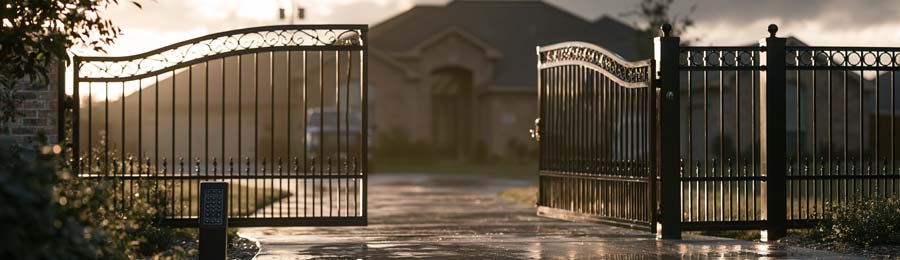
In Garland, a Gate Is Only as Good as Its Backup Power
Automatic driveway gates in Garland get judged on one thing the brochure does not mention: what happens when the power is out. Garland sits in storm and hail country, and the same systems that take down fences also take down the grid, often for hours at a time. A gate that only works when the electricity is on is a gate that traps your cars in the driveway during the exact week you most need to come and go. So before the configuration and before the access control, the first question on a Garland gate is how it operates when the line goes dead, and every system we install has an answer to that built in.
At Garland Fence Company we build that answer three ways. Every operator we install carries a battery backup sized to run the gate through a full outage, not just a flicker. On drives where running power is awkward, or where the homeowner wants to skip the grid entirely, a solar operator keeps its own battery charged off the consistent North Texas sun, which means a storm that drops the neighborhood’s power has no effect on the gate at all. And every gate, on any operator, has a manual release that opens it by hand in seconds without a tool. The gate keeps doing its job on the worst weather day of the year, not just the calm ones.
Swing or Slide Comes Down to the Driveway
The configuration is set by the driveway, not by preference. A swing gate opens on hinged panels, one or two, and is the common residential choice, but it needs clear room to swing: a driveway that climbs from the street can block an inward swing, and landscaping or a wall close to the opening can block an outward one. A slide gate runs sideways along a track beside the fence line and needs no room in front of or behind the opening, only enough fence run off to one side for the panel to retract into. That makes slide the right call on a sloped Garland driveway, a tight approach, or any drive that turns the moment it passes the gate. We measure the approach and the grade before specifying either one.
Wired, Battery, or Solar, and How You Open It
The operator is the motor that moves the gate, and the power source is where Garland conditions steer the choice. A wired operator pulls low-voltage power from the house or building and is the most straightforward where a power run is easy to reach, with battery backup carrying it through outages. A battery operator is self-contained for drives where running conduit is impractical. A solar operator is the off-grid option that pairs naturally with the storm-resilience point, since it never depends on the line at all. Whichever power source fits, the gate can be opened by keypad, remote, intercom, or a phone app, and for a homeowner who travels or runs a rental, the app’s open-and-close log is worth having. We rate every operator for the heat and cold a Garland driveway actually sees over ten or fifteen years, not the mild middle of the range.
Still Opening When the Grid Goes Dark
Automating the Gate You Already Have
If there is already a solid manual gate on the driveway, adding an operator to it is often smarter than buying a new one. The catch is the posts. An operator pushes and pulls a gate thousands of times a year with far more force than a hand ever did, and a post that was fine for a manual gate may not be set deep enough in Garland’s clay to take that load without working loose over time. So the first step on any conversion is a look at the posts: if they hold, the operator goes on the gate you have; if they do not, we reset them properly before mounting anything, because skipping that is how a converted gate sags within a year. And when an operator that has run for years starts failing, the fix is often a gate repair on its serviceable parts rather than a whole new system. A gate built to match an existing fence, or a custom gate fabricated to order, can also be hung and automated in one project.
Permits, Setback, and Standing Up to the Wind
A Garland gate can touch two permits: a fence permit when new posts or fence sections go in with the gate, and an electrical permit when a wired operator needs a new power connection. We handle both as part of the job and confirm the setback the city wants, so a car stopping at the keypad is not left hanging into the street or sidewalk while the gate opens. The gate panel itself gets the same wind consideration as the fences around it, since a tall solid gate leaf catches the same gusts that test a privacy fence, and the hinge posts and operator mounts are sized for that load. For a commercial access point, a heavier gate and operator pair with the rest of a commercial fencing perimeter, and we spec the whole entry to the traffic it will carry.
Every automatic gate estimate is measured on the driveway, because the grade, the approach, the gate width, and the power situation all set the system and the number, and a look at the actual driveway is the only way to spec it right.
Automatic Gate Questions
What happens to my automatic gate when the power goes out in Garland?
It still opens. Every operator we install in Garland includes a battery backup sized to run the gate through a full outage rather than just a brief dip, so a storm that drops the neighborhood’s power does not strand your cars. If the outage runs long, every gate also has a manual release that opens it by hand in seconds without a tool. And on a solar operator, an outage on the grid does not touch the gate at all, since it runs off its own charged battery. Losing power in a Garland storm is exactly the scenario these systems are built for.
Is a solar gate operator a good idea for Garland storms?
For a lot of Garland driveways, yes. A solar operator keeps its own battery topped up off the consistent North Texas sun, which means it never depends on the grid and a storm outage has no effect on it. It also skips the conduit run from the house, which can be the most awkward part of a wired install. Solar suits gates that sit a distance from a power source or homeowners who simply want the gate off the grid for storm season. The one requirement is reasonable sun exposure at the gate location, which we check during the estimate before recommending it.
Should I get a swing gate or a slide gate for my Garland driveway?
The driveway decides, not preference. A swing gate opens on hinged panels and is the common residential choice, but it needs clear space to swing open, which a sloped or tight driveway often does not have. A slide gate runs sideways along a track and needs no room in front of or behind the opening, only open fence run to one side for the panel to retract into. On a Garland drive that climbs from the street or turns right inside the gate, slide is usually the answer. We measure the grade and the approach before specifying either, because getting this wrong is expensive to fix later.
Can I add an operator to the manual gate I already have?
Often, yes, and it is usually the smarter move than buying a whole new gate. The deciding factor is the posts. An operator moves the gate with far more force than a hand does, thousands of cycles a year, and a post set for a manual gate may not be deep enough in Garland’s clay to take that load over time. So a conversion starts with a look at the existing posts: if they are solid, the operator mounts to the gate you have; if they are not, resetting them first is the right step, not an upsell. Done that way, a converted gate runs as reliably as a new install.
Do I need a permit for an automatic driveway gate in Garland?
Usually yes, and sometimes two. Garland requires a fence permit when new posts or fence sections go in alongside the gate, and an electrical permit when a wired operator needs a new power connection. The city also applies a setback rule so a vehicle stopped at the keypad is not left blocking the sidewalk or street while the gate opens. We handle the permit applications as part of the installation and flag any setback issue during the estimate, before the work is scheduled.
How much does an automatic driveway gate cost in Garland?
Automatic driveway gate cost in the Garland and greater DFW area covers a wide range, generally starting around $3,500 to $5,000 for a basic single-swing setup with an operator and running well into five figures for a dual-swing or slide gate in ornamental iron with solar power and smartphone access control. The biggest drivers are the gate size and material, swing versus slide, the operator and power source, the access control, and whether the posts need to be set or reset. Converting an existing gate costs less than a full new installation. Because every driveway is different, the only accurate number comes from measuring the gate opening and the approach on-site.