
Chain Link Fence Installation for Garland Dog Runs and Big Back Yards
Galvanized and black vinyl-coated chain link installed across Garland for dog runs, side and rear property lines, and the working back of the lot, where the job is covering ground securely rather than making a statement at the street.
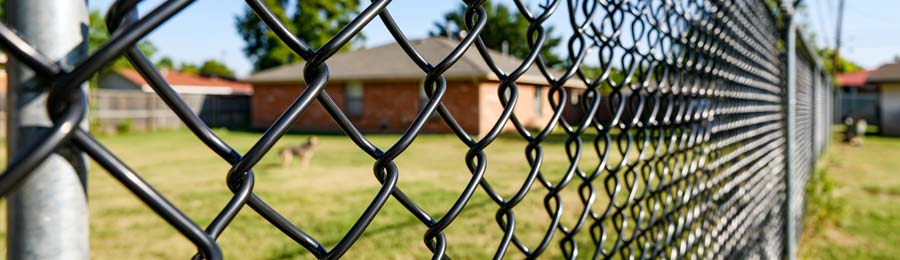
Chain Link Earns Its Keep on the Back Half of a Garland Lot
Chain link fence installation in Garland is rarely about the front of the house. It is about the dog that needs a run, the half-acre back line that has to be enclosed, the side yard between houses, and the working corners of the lot where what matters is a secure boundary, not a showpiece. Garland is a city of practical, value-minded homeowners on larger established lots, and chain link encloses more ground, with less upkeep, than any other material we install, while standing up to North Texas weather for decades. Where a wood or iron fence handles the street view, chain link quietly does the rest.
That split is common enough in Garland that as a Garland Fence Company we install plenty of properties twice over: a wood privacy fence or an iron panel along the visible line, and chain link on everything behind it. It helps that Garland has far more older, non-deed-restricted neighborhoods than the newer suburbs to the north, so chain link is allowed on a lot more of the property here than it would be under a Plano HOA covenant. Outside of any front-yard or corner rules the city applies, most of Garland is open to it.
Galvanized Silver or Black Vinyl That Disappears
Two finishes cover almost every Garland job. Galvanized chain link is the familiar silver metallic, zinc-coated against rust, and it is the standard where the fence is purely functional, like a back utility run or a kennel. Black vinyl-coated chain link adds a PVC layer over the galvanized wire, and in a back yard it does something galvanized cannot: it visually recedes. Against grass and a tree line the black mesh reads as almost nothing from the house, which is why it is the common pick when the fence is in view from the patio even if it is not in view from the street. For any run someone will look at from the yard, the vinyl-coated is usually the better call, and we cover the trade-offs on the estimate.
How High and How Heavy for a Dog or a Big Yard
Height is set by what the fence has to contain. A four-foot run marks a boundary and holds a small or mid-size dog; five and six feet are standard where a larger or jumping dog is the reason for the fence, and six feet is where most full back-line enclosures land. Gauge is the part most homeowners do not think to ask about, and it matters more than height for how long the fence stays taut. The wire runs from a heavy 9-gauge to a light 12.5-gauge, and for a Garland back yard the right balance is 11 or 11.5-gauge: strong enough to take a dog leaning on it and to hold tension across a long run, without the overkill of the commercial-grade wire a back yard does not need. For a kennel or a hard-use run, we step the gauge and the post size up, and spec all of it to the job rather than to a stock package.
The Working Fence for Garland's Back Lines
How Privacy Slats Close Off a Chain Link Line
The one knock on chain link is that you can see through it, and there is a fix that does not mean tearing the fence out. Privacy slats are vinyl strips woven vertically through the mesh, and they block most sightlines while leaving the structure of the fence exactly as it was. They come in several colors, they can go in during the original build or get added to a chain link fence already standing, and from any distance the result reads much more like a solid fence than an open mesh. Windscreen fabric is the other option, clipping to the outside of the fence to cut both sightlines and the wind coming through the line, which is why it shows up around sport courts, pool equipment, and exposed back corners. Either one turns a working chain link line into something closer to a screen without tearing it out and starting over in wood.
Following Garland’s Grade Without Gaps
Chain link is the most forgiving fence material on uneven ground. On a gradual Garland slope the fabric can be tensioned to follow the grade in one continuous line, with the bottom pulled tight and staked so there is no gap for a dog to push under. Where the drop is steeper, a stepped install, with level sections that drop with the grade, gives a cleaner line. The posts still get set in concrete to a depth that holds in Garland’s clay, since a chain link line goes slack fast if the terminal and corner posts move. For commercial yards, construction sites, and equipment perimeters, the same material scales up on heavier gauge and posts, and a commercial fencing estimate covers those specs. When an existing chain link fence has a sagging top rail, a bent post, or torn fabric, that is usually a chain link repair rather than a replacement.
Every chain link estimate is measured on the property, because the height, the gauge, the gate count, and the length of the run are what set the number, and a look at the actual yard is the only way to quote it right.
Straight Answers on Chain Link in Garland
Can a chain link fence be made private in Garland?
Yes, and without replacing the fence. Privacy slats are vinyl strips woven vertically through the mesh that block most sightlines while leaving the structure intact, and they can be added to a chain link fence that is already up. Windscreen fabric clips to the outside of the fence and cuts both the view and the wind through the line. Slats come in several colors and from a distance read much like a solid fence. For a Garland back yard where the chain link is doing its job but you want it less see-through from the patio, slats are the usual answer and cost a fraction of swapping the whole line for wood.
Galvanized or black vinyl-coated, which is better for a back yard?
For most Garland back yards, black vinyl-coated. Galvanized is the silver metallic chain link most people picture, zinc-coated against rust, and it is the right call for a purely functional run like a kennel or a utility area where looks do not matter. Vinyl-coated adds a PVC layer over the wire, usually in black, that gives a second barrier against rust and, more noticeably, visually disappears against grass and trees. The cost difference is small and the appearance difference is large, so anyone who will see the fence from the yard is usually happier with the vinyl-coated. Galvanized still wins on price for runs nobody looks at.
What gauge chain link should I use for a Garland back yard?
Chain link wire is measured in gauge, running from a heavy 9-gauge down to a light 12.5-gauge, and lower numbers are thicker. For a residential Garland back yard, 11 or 11.5-gauge is the sweet spot: heavy enough to hold tension across a long run and take a dog leaning on it, without the cost and overkill of commercial 9-gauge wire. If the fence is containing a large, strong dog or taking hard daily use, stepping up the gauge and the post size is worth it. We match the gauge to what the fence actually has to handle rather than installing one spec for every job.
How long does a chain link fence last in Garland?
A chain link fence in Garland will commonly last 20 years or more, and a galvanized or vinyl-coated line with sound posts can run well past that with almost no maintenance. There is no staining, sealing, or painting cycle the way there is with wood. The parts that eventually need attention are the tension hardware and the posts, especially the terminal and corner posts that carry the pull of the fabric, which is why setting them properly in Garland’s clay matters at install. Damaged fabric or a bent post is usually a repair, not a reason to replace the whole fence.
What height of chain link will keep my dog in the yard?
Height depends on the dog. A four-foot fence marks a boundary and holds many small and mid-size dogs, but a larger dog or a determined jumper usually needs five or six feet, and six is the most common height for a dedicated run or a full back-line enclosure. Just as important as height is pulling the bottom of the fabric tight and staking it down, since a dog that cannot go over will try to go under. For a serious digger or jumper we can add a bottom tension wire or a dig guard. We size the height and the setup to the specific dog rather than guessing.
How much does chain link fence installation cost in Garland?
Chain link is the most affordable fence material to install in the Garland and greater DFW area, generally running about $12 to $25 per linear foot for a standard residential galvanized or vinyl-coated fence, with vinyl-coated, taller heights, and heavier gauges pushing toward the upper end. Gates, the number of corner and terminal posts, the slope, and whether an old fence has to come out all move the number. Commercial-grade chain link with 9-gauge fabric and heavier posts prices higher per foot. Because the run length, the gauge, and the gate count drive the total, the only accurate figure comes from measuring the actual yard.