
Fence Questions Answered for Garland and the Eastern DFW Area
Common questions about fence installation, repair, materials, permits, storm damage, and specialty services across Garland, Rowlett, Sachse, Wylie, Mesquite, and Rockwall. Full answers below, organized by topic. For questions specific to a particular service, each service page on Garland Fence Company carries its own detailed FAQ section.
Starting a Fence Project in Garland
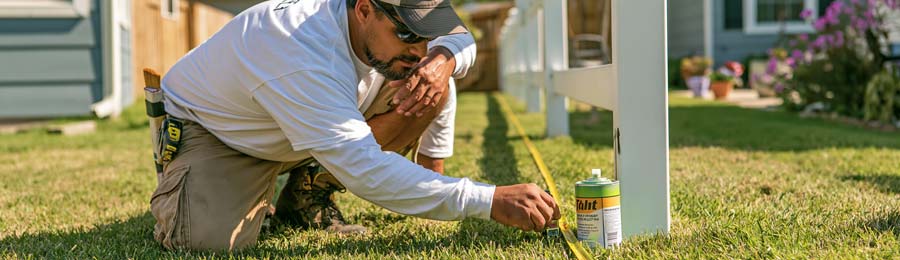
Do I need a permit to install or replace a fence in Garland, Texas?
Yes. The City of Garland requires a permit for any fence installation or replacement, regardless of material or fence height. The residential permit fee is $88 — a $70 base fee plus an $18 processing fee. Garland also enforces height and setback rules that vary by fence type and lot position: wrought iron and ornamental iron in front yards are limited to 3.5 feet, and corner lots can carry additional sightline requirements. We pull the permit as part of every installation job. If you have an existing fence that was never permitted, or if you have received a notice about a fence that does not meet the city’s current requirements, we can review the situation and advise on the correction before the permit application is filed.
How long does fence installation typically take in Garland?
Most residential fence installations in Garland run one to two days for the installation itself, but the total timeline from estimate to finished fence depends on what the job involves. If posts have to be pulled and reset in Garland’s clay, the concrete needs cure time before the panels go up — typically 24 to 48 hours. Custom gate fabrication adds lead time before the installation day. After a major storm, contractor schedules in the Garland area fill quickly and lead times stretch, which is why calling early — before the insurance adjuster, not after — gets you in the queue sooner. We give realistic timelines on the estimate call, not best-case numbers.
Can I get an estimate without being home in Garland?
Yes. If the fence line is accessible from the exterior of the property, we can walk it, take measurements, and prepare a written estimate without anyone present. We follow up with the estimate and our observations in writing. If the job involves interior work — a gate that can only be assessed from inside, or a yard that is not accessible from the street — we set a time that works.
Materials for North Texas Conditions
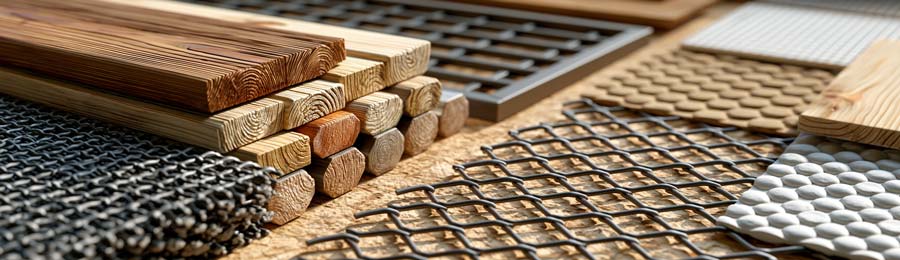
Is cedar or pine better for a wood fence in Garland?
Cedar. For Garland’s climate — wet springs, dry summers, and the constant wet-dry cycling that moves clay soil — cedar’s natural oils give it far better resistance to rot and insect damage than pine. Pine absorbs moisture faster, warps and checks sooner, and needs sealing earlier and more often. It is cheaper to buy the day the fence goes up, but cedar consistently outlasts it and costs less per year over the full life of the fence. For most Garland yards, cedar is the right call.
What is the difference between wrought iron and aluminum ornamental fencing?
What is sold today as wrought iron is almost always powder-coated steel — not true wrought iron, which is rarely fabricated anymore. Steel is stronger and carries more visual weight, which suits heavy gates and commercial perimeters, but it relies on its powder-coat finish to hold rust back. Aluminum does not rust at all, because the corrosion resistance is in the metal itself, not a coating applied over it. That makes aluminum a lower-maintenance option over the years and it often costs less per linear foot. For most Garland residential applications, the decision comes down to gate size, appearance preference, and how much long-term maintenance you want to manage. We price both options on the same estimate.
Will vinyl fencing hold up in Garland's summer heat?
A properly formulated vinyl fence will not fade, yellow, or warp in Garland’s sun and heat. The UV inhibitors and impact modifiers in a quality panel are blended into the PVC itself — not applied as a surface treatment — so they last through summer after summer rather than breaking down. The color runs through the full thickness of the material and cannot bleach off. The vinyl that yellows and grows brittle is the thin, under-formulated kind, and we spec around it on every job. With the right panel, Garland’s heat is not a problem the fence ever shows.
What gauge chain link should I use for a Garland back yard?
For a residential Garland back yard, 11 or 11.5-gauge is the right range — heavy enough to hold tension across a long run and take a dog leaning into it, without the cost and overkill of commercial 9-gauge wire. If the fence is containing a large or strong dog, or seeing hard daily use, stepping up to a heavier gauge and larger posts is worth it. We match the gauge to what the fence actually has to handle rather than specifying one standard for every job.
Repair, Replacement, and Garland's Aging Fence Stock
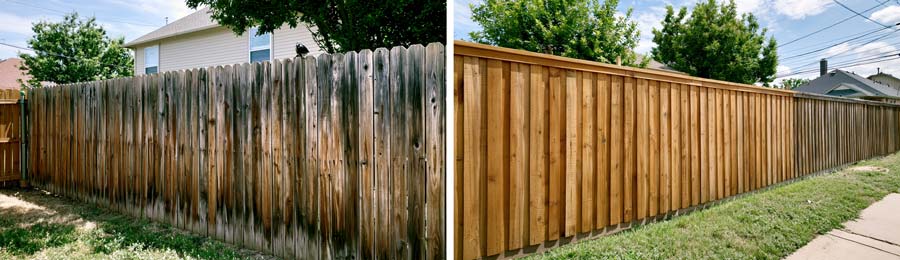
Should I repair or replace my fence in Garland?
It depends on the posts. If the posts are plumb and solid at the soil line and the damage is limited to boards, a section, or a gate, repair is the right and faster call. If posts have failed across several sections, if the boarding is deteriorated across a stretch rather than just a panel or two, or if the fence has simply reached the end of its service life, replacement is the better decision because further repairs would only chase the next failure. Garland’s housing stock was built heavily in the 1980s through early 2000s, which means a large portion of original fence installations are at or past that point right now. We assess the full fence line and put both options in front of you with real numbers before any work starts.
Why is my Garland fence leaning when the boards still look fine?
A leaning fence is almost always a post problem, not a board problem. Garland sits on expansive clay that swells when it absorbs water and contracts through a dry summer. A post that was set too shallow, or that was set correctly twenty-five years ago and has since absorbed a full generation of that movement, gets worked loose until it leans and pulls its section with it. The boards above can look sound while the post beneath has given up. That is why a leaning fence gets fixed at the post — not by bracing the boards — and why we check the posts on either side too, since a failing post usually has neighbors working their way to the same point.
Who is responsible for fence repair between neighbors in Texas?
Texas law does not require neighbors to split fence repair costs unless there is a written agreement or an HOA rule that creates the obligation. On a shared property line without one of those in place, cost-sharing is a conversation between neighbors rather than something the law compels. We can provide a written estimate that documents the damage, the scope, and the cost, which is useful for that conversation either way. If a property-line dispute raises questions about whose ground the fence sits on, that is a matter for a real estate attorney rather than a fence contractor.
How often does a wood fence need staining in Garland?
A wood fence in Garland generally needs re-staining every two to three years. The fence tells you when it is due: water stops beading on the boards and starts soaking in, the color fades, and the silver-gray weathering creeps back across the face of the wood. Staying on that schedule — rather than waiting until the fence looks bad — is what keeps a wood fence reaching its full lifespan instead of aging out years early. A brand-new cedar fence is the exception: green cedar has to cure for 30 to 60 days before it will hold stain properly.
Storm Damage and Insurance in Garland
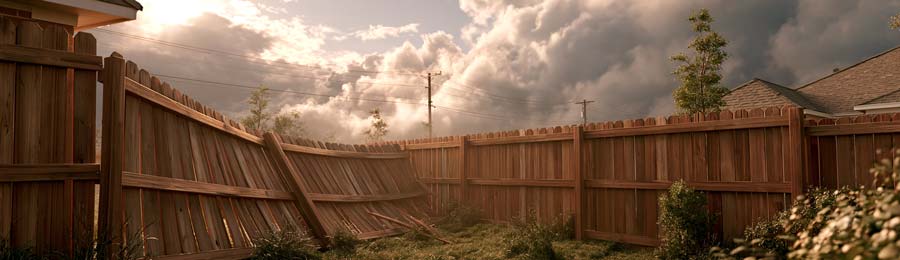
Does homeowners insurance cover storm damage to a fence in Garland?
Most standard Texas homeowners policies cover sudden fence damage from wind, hail, and fallen trees, while gradual deterioration and normal wear are excluded. Whether filing a claim makes sense depends on your repair or replacement cost measured against your deductible. Photograph the damage before any cleanup or temporary repair, and contact your insurer before authorizing permanent work. We provide a written damage assessment and estimate formatted for an insurance adjuster. When the damage points toward a full replacement, the process and the coverage details are covered in depth on the storm damage replacement page.
What should I do immediately after a storm damages my fence in Garland?
Photograph the damage before you move anything — the downed sections, the debris or limb that caused it, and the base of any failed posts, while the yard is still exactly as the storm left it. Once the yard is cleared, that evidence is gone and the claim is harder to document. After photos, a temporary barrier to keep pets and children contained is reasonable and is usually treated as an emergency measure under the policy, so save the receipts. Then call for an on-site assessment, ideally before the adjuster visits, so the written estimate and damage documentation are ready when the claim is reviewed.
Can I switch materials when replacing a storm-damaged fence in Garland?
Yes. Insurance pays the like-for-like portion of the replacement — what it cost to replace what you had with a comparable new fence — and you can apply that amount toward a different material and cover the upgrade cost yourself. A storm replacement is a natural moment to make that change, since the fence is coming out regardless. We write the estimate with the covered like-for-like amount separated from any upgrade cost so the claim stays clean and you can see exactly what the upgrade adds to your out-of-pocket share.
Which fence holds up best in Garland storms?
By wind resistance, chain link leads — air passes through the mesh rather than pushing against it, which is why it survives high-wind events better than any solid fence. Ornamental iron and aluminum do nearly as well because of the open picket design, and hail that splits cedar boards does little to metal. A solid wood privacy fence catches the most wind load of any common material, so with wood the deciding factor is how deep and well the posts are set. A properly set wood fence can survive the same storm that brings down a shallow-set one. Vinyl flexes under a gust rather than resisting it rigidly, and on sound posts it holds up well. The right answer depends on what the fence has to do, and a storm replacement is a good moment to weigh it.
Gates, Commercial, and Specialty Services
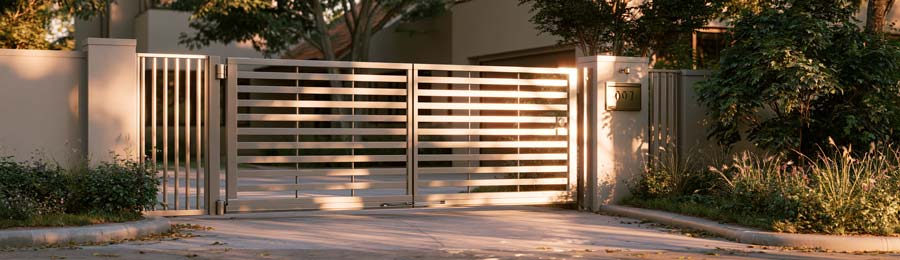
Should I get a swing gate or a slide gate for my Garland driveway?
The driveway decides, not preference. A swing gate opens on hinged panels and is the standard residential choice, but it needs clear space to arc open — which a sloped or tight driveway often does not have. A slide gate moves laterally along a track and needs no clearance in front of or behind the opening, only an open fence run to one side for the panel to retract into. On a Garland drive that climbs from the street or turns right inside the gate, slide is usually the answer. We measure the grade and the approach during the estimate and specify the type before any work is scheduled, because getting that decision wrong is expensive to correct.
Do I need a permit for an automatic driveway gate in Garland?
Usually yes, and sometimes two. Garland requires a fence permit when new posts or fence sections go in alongside the gate, and an electrical permit when a wired operator needs a new power connection to the house. The city also applies a setback rule so a vehicle waiting at the keypad is not left blocking the sidewalk or street while the gate opens. We handle the permit applications as part of the installation and flag any setback issue during the estimate, before the work is scheduled.
What type of fencing works best for a commercial property in Garland?
It depends on what the fence has to do. For a secured perimeter, an equipment yard, a fleet lot, or a construction enclosure, commercial-gauge chain link is the standard choice — it gives a strong, durable boundary at a working price and accepts barbed or razor topping where extra deterrence is needed. For a street-facing frontage, an office, or a building entrance on one of Garland’s commercial corridors, ornamental iron presents a finished boundary while still controlling access. Many Garland commercial properties use both: iron where the public sees it, chain link around the working perimeter behind. We match the material to each part of the property during the site walk.
Can a custom gate be matched to an existing fence in Garland?
Yes, and on older Garland fences it is most of the work. Weathered boards have aged to a color new lumber does not start at, the original profile may be out of production, and there is usually no record of what was installed or by whom. We handle it by reading the fence directly — the material, the profile, the rail spacing, the finish — then fabricating the gate and staining or coating it to land as close to the existing line as the weathering allows. It will not be invisible on day one if the old fence is heavily silvered, but it will weather in, and it matches the original far better than any stock panel off a shelf.
Still Have a Question? We Can Answer It on the Property.
Every estimate is free, includes a full walk of the fence line, and gives you the information you need to make a call — on repair, replacement, material, or any other question specific to your property in Garland, Rowlett, Sachse, Wylie, Mesquite, or Rockwall.