
Vinyl Fence Installation Spec'd for Garland's Sun
Commercial-grade privacy, semi-privacy, and picket vinyl installed across Garland in panels formulated to hold their color and their strength under Texas sun, so the fence still looks new years after a lesser panel would have yellowed and cracked.
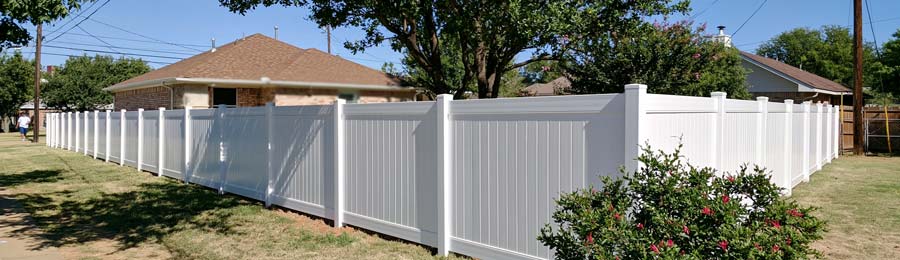
With Vinyl, the Grade You Buy Is the Fence You Get
Vinyl fence installation in Garland comes with a catch no other fence material has: a lesser panel and a properly built one look identical on the day they go in, and completely different five years later. Both are white panels on white posts at the estimate. But Garland’s sun is hard on plastic, and a panel made from a thin, under-formulated compound will yellow, grow brittle, and start cracking within five to seven summers, while a properly built one still looks new. With wood you can read the grade in the lumber. With vinyl the quality is invisible until the sun finds it, which is why what you are actually buying matters more here than with any other fence.
At Garland Fence Company, we spec commercial-grade vinyl on every residential job rather than the builder-grade panels that look the same on the rack, because we are the ones who get the call when a fence fails early, and in Garland sun the under-built panel fails early. That means a minimum wall thickness, UV inhibitors and impact modifiers blended into the PVC itself, and posts and rails sized to the panel. The point is not to upsell a premium product. It is that on vinyl, the floor has to be high enough to survive the climate, and we hold it there.
Why the Compound Matters More Than the Color
The threat to vinyl in Garland is not impact or moisture. It is ultraviolet. Sustained summer UV is what turns weak vinyl yellow and brittle, and the defense against it is built into the material, not sprayed on top. Quality panels carry UV inhibitors and impact modifiers blended through the full thickness of the PVC, so there is no coating to chalk or peel, because the protection is the panel. Wall thickness is the other number that decides longevity: residential privacy panels should run a minimum wall thickness around an eighth of an inch, and thinner extrusions are where the cracking starts. None of this shows in a photo or a showroom sample, which is why we name the spec on the estimate instead of letting the panel get chosen on looks alone.
Privacy, Semi-Privacy, and Picket on a Garland Lot
Vinyl comes in the same three forms most Garland yards want. A solid privacy panel runs board-to-board with no sightlines and is the direct stand-in for a wood privacy fence on a rear yard. Semi-privacy spaces the boards slightly to let air move through the line, which eases wind load and suits a side yard where full enclosure is not the goal. Picket keeps the open, traditional look for a front yard that defines the property without closing it off. White is far and away the most common color in Garland, with tan, almond, and gray available, and because the color runs through the material rather than sitting on top, it never needs repainting to stay even. Where a neighborhood does have an HOA, that consistent, unchanging color is part of why vinyl tends to sit well with it.
Still Looking New After Ten Garland Summers
Setting Vinyl to Stand in Garland Clay and Wind
A vinyl fence lives or dies on its posts. The panels themselves flex under a gust rather than fighting it rigidly, which is part of why vinyl handles high wind well, but that only holds if the posts underneath are set right. In Garland’s expansive clay, vinyl posts get set in concrete to a depth sized for the soil movement and the panel height, because a post that heaves or leans takes the whole run with it. Reinforced posts or steel inserts go in on taller privacy runs and on gate posts, where the load is highest. The flex is engineered into the product; the staying power comes from how it is anchored, and that is the part of a vinyl job that does not show once the fence is up.
The Upkeep Is a Garden Hose
Once it is in, a vinyl fence asks for almost nothing. There is no staining, no sealing, no painting, and no annual checking for gray boards or rot, because there is nothing in the material to rot. A quality panel holds its color on its own. The only maintenance is rinsing off dust and pollen with a garden hose, or soap and water on a stubborn spot, a couple of times a year. If a panel does take damage from an impact, vinyl is built in sections, so a vinyl fence repair usually means swapping the affected panel rather than rebuilding the run. For homeowners weighing it against wood, a wood privacy fence still makes sense on a shorter timeline or a tighter start, and we lay both out honestly on the estimate.
Every vinyl estimate is measured and specced on-site, because the panel grade, the style, the height, and the gate count all set the number, and a walk of the property is the only way to quote it and to confirm the grade going in.
What Garland Buyers Ask Before Choosing Vinyl
How can I tell if a vinyl fence is built to last in Garland's sun?
The difference is in the compound and the wall thickness, and neither one shows in a showroom sample. Ask what the panel’s wall thickness is, since residential privacy panels should run a minimum of about an eighth of an inch and thinner extrusions are where cracking begins. Ask whether the UV inhibitors and impact modifiers are blended into the PVC itself or applied as a surface treatment, because only the first kind survives Garland sun over the long haul. Ask about the post reinforcement on taller runs and gates. A panel that looks identical to a budget one on the day of install can be a completely different fence in five years, so we name the grade on every estimate rather than leaving it to chance.
Will a vinyl fence warp or fade in Garland's summer heat?
A quality vinyl fence will not fade, yellow, or warp in Garland’s heat. The UV inhibitors built into a properly formulated panel hold the color and the flexibility steady through summer after summer, and the color runs through the full thickness of the material rather than sitting on the surface, so there is nothing to bleach off. The vinyl that does yellow and grow brittle within a few years is the thin, under-formulated kind, which is exactly the failure we spec around. With the right panel, Garland’s sun is not a problem the fence ever shows.
How long does a vinyl fence last in Garland?
A quality vinyl fence in Garland will commonly last 25 to 30 years or longer, and reputable manufacturers back the panels with warranties in that range. Because there is no staining, sealing, or rot to manage, the fence does not go through the gradual decline a wood fence does in its later years. The posts are the part that determines whether it reaches that lifespan, which is why setting them properly in Garland’s clay matters as much as the panel grade. Buy the right vinyl and set it right, and it is realistically the last fence you install on that line for decades.
Is vinyl worth the higher upfront cost over a wood fence?
Vinyl costs more upfront than a comparable wood fence in the Garland area, typically running 20 to 40 percent more per linear foot installed depending on style and grade. The picture changes over time. A wood fence needs staining every few years, repairs in its middle years, and full replacement in 15 to 20, while a quality vinyl fence needs none of that and lasts 25 to 30 or more. Counted over the full life of the fence, the two often land close, and vinyl can come out lower once the wood maintenance and earlier replacement are added in. The right call depends on how long you plan to stay and how much upkeep you want to manage, and we cover both on the same estimate.
Does a vinyl fence hold up in Garland's storms and wind?
Vinyl handles Garland’s wind better than its solid look suggests. The panels are engineered to flex under a gust rather than resist it rigidly, and a semi-privacy style lets some air pass through the line to cut the load further. The deciding factor in any high-wind event is the posts: set to the right depth in concrete and reinforced on taller runs, they keep the fence standing through the same storms that test every other material. Post setting, not the panel, is where wind performance is won or lost, and it is accounted for on every installation.
How do you clean a vinyl fence?
Cleaning a vinyl fence is about as simple as fence maintenance gets. For routine dust, pollen, and the film that North Texas weather leaves behind, a garden hose handles most of it. For anything stubborn, like a scuff or mildew in a shaded corner, warm water with a little dish soap and a soft brush clears it without harming the finish, since the color is part of the material and cannot be scrubbed off. There is no power washing required and no sealing afterward. A couple of rinses a year keeps a vinyl fence looking the way it did the day it went up.