
Custom Gates for Garland, Framed in Steel So They Never Sag
Pedestrian and driveway gates fabricated in wood, iron, vinyl, and combination materials across Garland, built on a welded steel frame that holds its shape and matched to the fence you already have so the gate looks original, not added on.
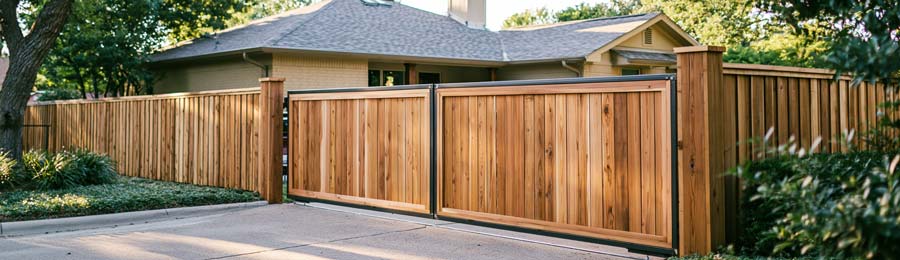
Why a Garland Gate Wears Out Before the Fence Does
On most Garland properties, the fence outlives the gate. Custom gates exist because the gate is the one part of a fence that moves, gets leaned on, swung a dozen times a day, and carries its own weight on two hinges, so it sags, drags, and racks out of square years before the panels beside it show any age. On Garland’s 1970s-to-2000s fences, the gate is usually the first thing to fail, and a stock panel from a home center will not match a fence that has weathered for two decades. A custom gate solves both problems at once: it is built to outlast the fence it hangs on, and it is matched to look like it was always part of it.
At Garland Fence Company, we build custom gates around a welded steel internal frame, even when the gate is clad in cedar or vinyl. A wood-only gate frame is held together by fasteners at the corners, and over a few Texas summers of swinging and weather those joints loosen and the frame twists into a parallelogram, which is the sag and the ground-drag everyone recognizes. A steel frame does not loosen and does not rack, so the cedar or vinyl on the outside is doing the looking while the steel underneath is doing the standing. The hinge posts get the same attention, set deep in concrete for Garland’s clay, because a frame that stays square is no help if the post it hangs on heaves.
Matching a New Gate to an Old Garland Fence
Most Garland custom gate calls are a match job: one gate has failed in a fence that is otherwise fine, and the replacement has to look like the rest of the line. That is harder than it sounds on an older fence, where the boards have weathered to a color new lumber does not start at, the original profile may be out of production, and there is rarely any record of who built it or what they used. The most reliable way to match it is to look at it, which is why the estimate is an on-site visit rather than a phone quote. We read the material, the profile, the rail spacing, and the finish off the actual fence, then build and stain or coat the gate to land as close to it as the weathering allows.
Cedar, Iron, Vinyl, or a Combination of Them
A custom gate can be built in any material we fence with. Cedar gates match a wood privacy fence and are clad over the steel frame so they carry the wood look without the wood-frame weakness. Ornamental iron gates are fabricated to the profile, rail spacing, and powder-coat finish of a wrought iron fence, and they also stand alone as a pedestrian or driveway gate where there is no fence to match. Vinyl gates are matched to the panel color and profile of an existing vinyl fence as closely as the manufacturer allows. And a combination gate, a steel frame with cedar or composite infill, is the right answer for a wide or heavy opening where one material gives the strength and another gives the face. The frame underneath is steel either way.
Steel-Framed to Stay Square for Decades
From a Walk-Through Gate to a Full Driveway Span
Custom gates cover everything from a three-foot walk-through to a driveway span. A pedestrian gate runs roughly 36 to 48 inches wide, matched to the fence height, for foot access in a fence line. A driveway gate covers the full opening, commonly 10 to 16 feet for a single or double drive, built as one panel or split into two so each leaf needs less room to swing. The advantage of building custom shows most on openings that are not a stock size, which describes a lot of Garland’s older lots, where the driveways and side passages were poured long before anyone standardized gate widths. We fabricate the gate to the opening that is there, instead of forcing the opening to fit a panel off a shelf. If the gate may ever be automated, we build it ready for it from the start, with the heavier hinge post, the weight distribution, and the operator mounting an automatic driveway gate needs, because adding those after the fact usually means rebuilding the gate.
Hinges and Latches That Take the Weather
A gate is only as good as the parts it swings on. The hinges, the latch, and any drop rod take the full weight and the full use of the gate out in the open air, so the cast-zinc hardware bagged with a stock gate corrodes and wears within a couple of Garland summers. We hang custom gates on heavy-duty galvanized or stainless hinges, with stainless or brass latches, and stainless screws or ring-shank galvanized nails at every cedar fastening point rather than staples. It is not the part anyone looks at, but it is the part that decides whether the gate still closes cleanly ten years in.
Every custom gate starts with a look at the opening and the fence it has to match, because the size, the material, the frame, and the hardware all set the build and the number, and a visit to the property is the only way to spec a gate that fits and lasts.
What to Know Before Ordering a Custom Gate in Garland
Why does my gate sag and drag when the rest of the fence is fine?
Because the gate is the only part of the fence that moves, and it carries its own weight on two hinges all day. A gate built on a wood-only frame is held at the corners by fasteners, and over a few Texas summers of swinging and weather those joints loosen and the frame twists out of square, which is the sag and the dragging on the ground you end up fighting. A heaving hinge post in Garland’s clay makes it worse. The fix is a gate built on a welded steel internal frame that cannot rack, hung on a hinge post set deep enough to stay put. Build it that way and the sag never starts.
Can you match a new gate to my weathered older fence?
Yes, and on an older Garland fence that is most of the work. Weathered boards have aged to a color new lumber does not start at, the original profile may be out of production, and there is usually no record of who built the fence or what they used. We handle it by coming out and reading the fence directly, the material, the profile, the rail spacing, and the finish, then fabricating the gate and staining or coating it to land as close to the existing line as the weathering allows. It will not be invisible on day one if the old fence is heavily silvered, but it will weather in, and it matches far better than any stock panel.
What materials can a custom gate be built from?
Any material we fence with. Cedar gates match a wood privacy or picket fence and are clad over a steel frame so they hold the wood look without the wood-frame sag. Ornamental iron gates are built to the profile and powder-coat finish of an iron fence, or as standalone pedestrian and driveway gates where there is no fence to match. Vinyl gates are matched to an existing vinyl fence’s color and profile as closely as the manufacturer allows. And a combination gate, a steel frame with cedar or composite infill, suits wide or heavy openings where one material carries the strength and another carries the appearance. The structural frame is steel in every case.
Should I have the gate built automation-ready even if I am not automating it now?
If there is any chance you will automate the gate later, yes, have it built ready now. The hinge post size, the gate weight and balance, and the operator mounting an automated gate needs are not always what a manual gate is built with. Specifying it ready at fabrication adds little to the build. Retrofitting a gate that was not designed for an operator often means a heavier post and partial rebuilding before the operator can even go on. The operator itself, the power source, and the access control are covered on the automatic driveway gate page, and can be added at install or down the road once the gate is built for it.
How long does a custom gate take to build and install?
It depends on the material. A cedar gate is usually ready within one to two weeks of confirming the order. An iron or combination gate that has to be welded and powder-coated runs two to four weeks depending on the shop’s current lead time. Installation comes after fabrication and is typically a half-day to a full day, longer only if new posts have to be set and given time to cure first. We give you the realistic timeline for your specific gate at the estimate, not a best-case number.
How much more does a custom gate cost than a stock one?
A custom gate costs more than a stock panel, generally running from a few hundred dollars more for a basic matched cedar pedestrian gate to a significant step up for a large welded-steel driveway gate in iron. What the difference buys is a gate fabricated to your exact opening, built on a steel frame that will not sag, matched to your fence, and hung on hardware that lasts. On a stock gate the savings show up once and the sagging shows up every year after. Because the price tracks the size, the material, and the frame, the only firm number comes from measuring the opening on-site.